
From R&D to Venture: Structuring Deep-Tech Commercialization
A research programme can succeed without becoming a company.
The technology may work, the prototype may demonstrate technical potential, and the team may produce intellectual property with real commercial relevance. The scientific case can be sound while the conditions for a viable venture remain incomplete. The distance between a successful research result and a scalable company is not measured by technical maturity alone; it may also depend on ownership, governance, venture structure, capital, market access, regulatory requirements, and the capacity to convert a technical asset into an operating business.
R&D creates potential, not necessarily a venture
R&D is organised around solving technical problems and producing knowledge or intellectual property. A venture has different operating requirements: a defined problem, a commercial application, an ownership structure, decision rights, resources, customers, capital, and mechanisms for execution.
A promising result may support more than one commercial route: licensing, embedding within an existing company, a partnership, or a new venture. The appropriate route depends on the nature of the asset, the rights attached to it, the market, and the capabilities required to reach customers. Commercialization is therefore not the closing stage of R&D; it is a separate set of structural and commercial decisions.
Ownership can become an early constraint
Deep-tech assets may originate in universities, research centres or institutional R&D programmes, and a technically valuable technology may carry ownership and licensing rights that remain distributed or insufficiently defined. Where those rights are unclear, decisions on investment, governance and operating responsibility become more complex, and an asset that is technically ready can stall before incorporation. The existing rights position is an input to route selection, since it constrains which routes are available. The ownership arrangement for the venture itself is settled afterwards, against the chosen route.
Intellectual property becomes convertible into commercial value when a route to use exists
Ownership alone does not determine how much value can be realised from intellectual property. Commercial potential may depend on what can be built around the asset: additional engineering, technical validation, regulatory readiness, manufacturing capability, data, partnerships, or integration with customer systems. The practical question extends beyond who owns the intellectual property to what structure and capabilities make it usable.
Pathway selection and venture architecture
Selecting the commercial route is a decision in its own right, and it precedes the design of the structure meant to serve it. Licensing, embedding, partnership and spin-out each imply different ownership arrangements, capital requirements and capability sets.
Once the route is chosen, further decisions follow: the first product and market, the milestones to reach before additional capital is committed, the capabilities retained by the originating institution and those transferred, the allocation of decision rights, and the ownership of assets to be developed.
Venture architecture is the structure surrounding the technical asset: the entity, the ownership model, governance, the capital plan, and capabilities. A licensing route resolves it into a small entity holding rights and royalty flows; a spin-out serving regulated customers resolves it into a capitalised company with its own governance, technical ownership and, where the sector demands it, a certification path. The route sets the architecture, not the reverse.
Capital strategy should reflect technical and commercial stages
Deep-tech companies may operate on timelines that differ from conventional software businesses: validation may take time, manufacturing may require substantial investment, regulatory requirements may affect sequencing, and adoption may depend on pilots, certifications or integration. A company benefits from knowing the capital required at each stage and the milestone that funding is meant to support. A financing round is an input to the wider strategy rather than a substitute for it.
Market and regulatory conditions shape the route
Identifying an opportunity does not by itself create a route to commercialization. Adoption may depend on procurement structures, technical compatibility, customer risk tolerance, and the ability to demonstrate reliability in real operating environments. Regulatory requirements may in turn shape product architecture, data handling, testing and market entry, and they vary by technology, activity and jurisdiction, which makes it appropriate to treat them as part of venture design rather than a closing compliance exercise, particularly where the technology interacts with sensitive data, financial systems, critical infrastructure or other regulated activity.
A spin-out needs operational autonomy to execute
A spin-out is not an R&D project registered as a company. It requires an operating model covering leadership, governance, financial controls, technical ownership and product priorities. The originating institution may continue to provide capabilities or strategic support, while the new company needs sufficient authority to decide against its own commercial objectives.
Institutional context in the Kingdom
King Abdulaziz City for Science and Technology, with the Research, Development and Innovation Authority, has launched a deep-tech commercialization camp for research teams holding prototypes or advanced technologies ready for testing and commercial use, through sessions and applied workshops intended to raise the readiness of technical projects for commercial application. Separately, the Saudi Authority for Intellectual Property has issued guidance for universities and research centres on policies for managing, protecting and exploiting intellectual property.
These instruments raise readiness and give research institutions a framework for setting their own policies on holding and exploiting rights. What remains, because it is specific to each asset, is choosing the route for a given technology and designing the entity, ownership split and capital plan that follow from it. That sits with the parties building the venture.
From technical asset to strategic asset
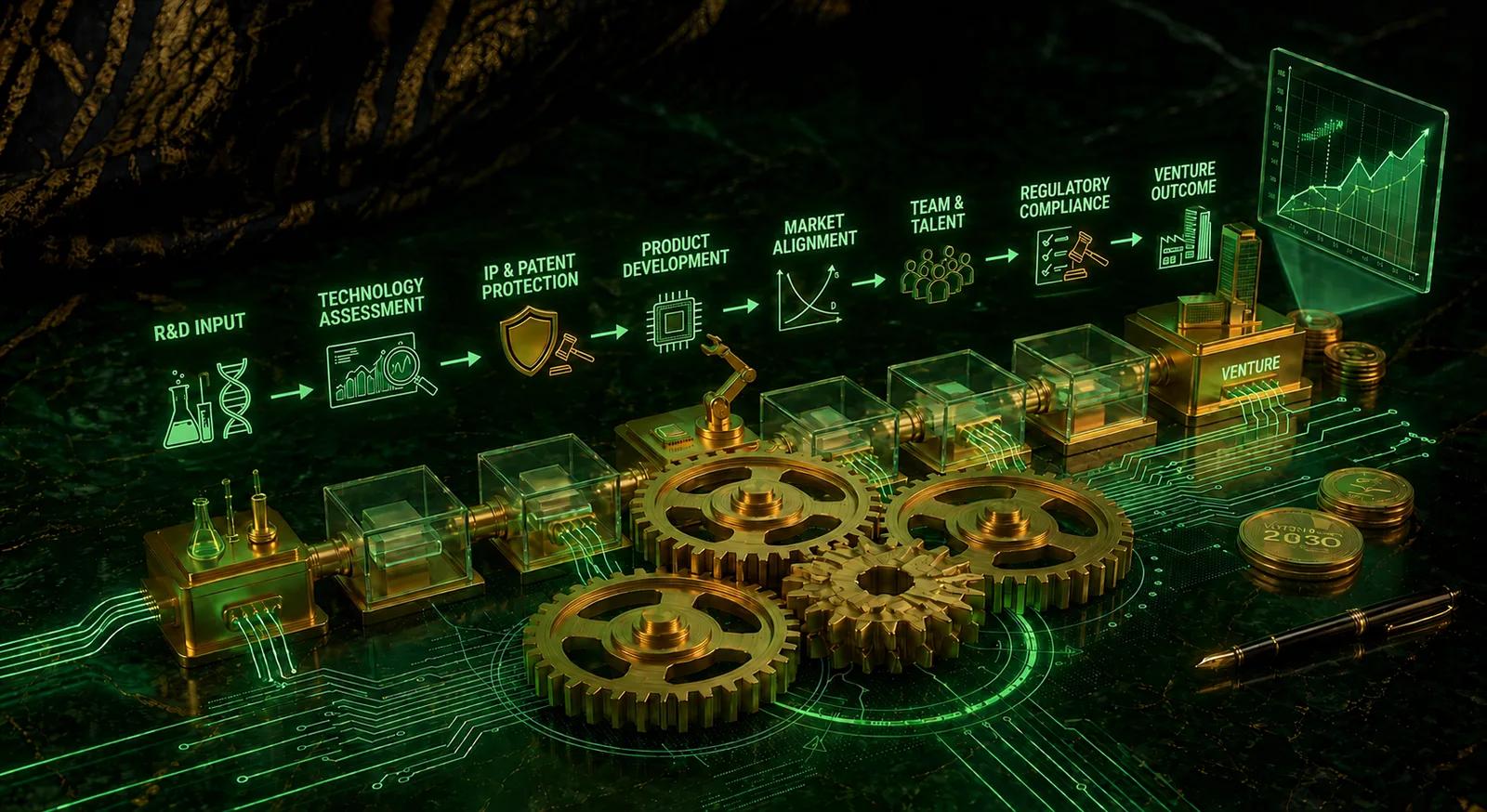
The move from R&D to a venture is neither a single handover nor one sequence for every case. For the route leading to a venture, the chain below maps the principal decisions:
R&D → Intellectual property → Rights position → Pathway selection → Venture architecture → Commercialization → Scale
Venture architecture is the composite step: entity, ownership model, governance, capital plan and capabilities, designed against the chosen route.
This is a decision framework, not a linear process: elements may develop in parallel, decisions may return to earlier stages, and the route may differ by technology and market.
At B&P Horizon, the work sits between technical potential and venture execution: establishing the rights position on an asset, selecting the route, structuring the entity and ownership split, and building the capital plan against the technical and commercial milestones the route requires.
The practical question is not whether every research output should become a venture, but whether the chosen route holds the ownership, governance, capital, capabilities and market path required to execute.