
Post-Merger Integration: Turning Deal Thesis into Realized Value

Every acquisition is bought twice. The first purchase happens in the boardroom, where a valuation model, a control premium, and a persuasive strategic logic converge into a signed agreement. The second purchase happens over the following eighteen months, in operating reviews and system migrations and uncomfortable conversations about who now owns the customer relationship. The first transaction transfers ownership. Only the second transfers value. Executives who treat closing as the finish line have, in effect, paid a premium for an option they never exercise.
Why Deals Break After the Handshake
The statistics are unforgiving, and they have been for three decades. The range most frequently cited in the literature popularized in Harvard Business Review and echoed across studies from major consultancies places M&A failure somewhere between 70% and 90%. The spread is wide because "failure" is measured differently depending on who is counting: shareholder return against an index, synergy targets missed, or eventual divestiture at a loss. The variance in method matters less than the consistency of the finding. Most deals do not deliver what they promised.
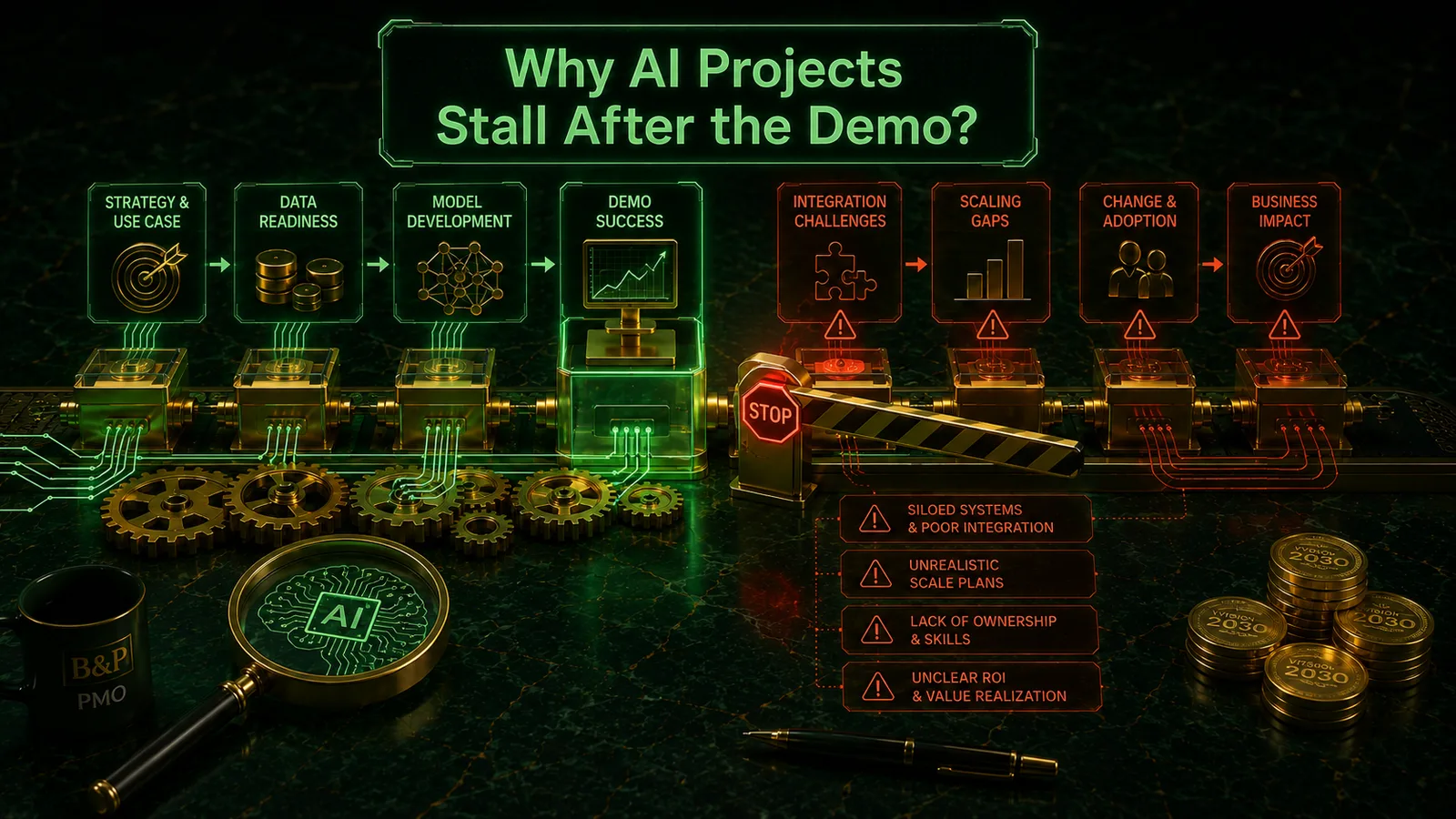
What is striking is where the failure originates. Post-mortems rarely conclude that the thesis was wrong. They conclude that the thesis was never executed. The strategic rationale market access, capability acquisition, scale economics usually survives scrutiny. What does not survive is the assumption that value flows automatically once two balance sheets are combined. Between the model and the outcome sits a wide, poorly-lit space where synergies quietly evaporate: duplicated roles nobody eliminates, contracts nobody renegotiates, customers nobody reassures, engineers who resign in month four. This is value leakage, and it is almost never a single dramatic event. It is a thousand small omissions, each individually defensible.
Disciplined post-merger integration exists to close that space. Its purpose is not administrative tidiness. It is the systematic conversion of a financial hypothesis into an operating reality, under a deadline, with named owners and measured results.
The First Hundred Days Are a Proof, Not a Plan
The 100 Day Plan has become something of a ritual, which is precisely the risk. Drafted as a document, it is theater; executed as a commitment, it is the single strongest predictor of integration success. The distinction lies in what the plan actually contains.
An effective 100 Day Plan begins before close, not after. It decomposes the deal model into discrete, attributable initiatives, this cost line, this cross-sell motion, this facility consolidation and assigns each to a named executive with a dated milestone and a defined baseline. It sequences ruthlessly: organizational bandwidth in the first quarter is the transaction's scarcest resource. And it distinguishes between decisions that must be made immediately, however imperfectly, and decisions that benefit from deliberation. Ambiguity is the enemy here. Employees on both sides will tolerate difficult news far better than they tolerate silence; in the absence of communication, they will construct a narrative, and it will rarely be the flattering one.
Culture Is the Operating System, Not the Soft Layer
Culture is routinely dismissed as the qualitative afterthought of integration planning, which explains why it appears so often in the autopsy. A more useful framing: culture is the set of default behaviors that govern how decisions get made when no policy applies. When an acquirer with a consensus-driven, risk-averse decision model absorbs a target built on rapid autonomous execution, the collision is not a matter of sentiment. It is an operational failure mode. Approvals slow, initiative dies, and the very capability the acquirer paid to obtain begins to dissolve.
Serious cultural integration starts with diagnosis rather than declaration. Map how each organization actually makes decisions, allocates authority, tolerates failure, and recognizes performance. Then make deliberate choices about which model governs which domain full absorption in finance and compliance, perhaps, alongside preserved autonomy in product or research. What matters is that the choice is explicit and communicated. Cultures do not merge by proximity; they merge by design or they fracture by default.
Synergies Do Not Exist Until They Reach the P&L
Operational and technology synergies are where deal models are most confident and integration reality is most humbling. Platform consolidation, ERP migration, data harmonization, and shared services rationalization are multi-year undertakings routinely underwritten in the model as twelve month wins. The result is a predictable pattern: costs arrive on schedule while benefits slip.
The corrective is a hard tracking discipline. Every synergy in the model should be traceable to a specific line in the operating budget, with a baseline captured at close and a monthly variance review that treats a missed integration milestone with the same gravity as a missed earnings forecast. Sequencing matters as much as ambition. Stabilize the revenue base first, protect the customer experience through the transition, and defer the most invasive systems work until the combined organization has demonstrated it can execute together on something smaller.
Governance Prevents Drift
Integration fails quietly when accountability diffuses. The antidote is a governance structure with genuine authority: an Integration Management Office with executive sponsorship, decision rights that do not require escalation for every trade-off, a review cadence that survives the competing priorities of quarter three, and a single dashboard tracking synergy capture, attrition, and customer retention side by side. Dedicated leadership matters. Integration run part-time by executives already accountable for their day jobs will always lose to the day job.
The Assets That Can Resign
In capability-driven acquisitions technology, professional services, specialized manufacturing the acquired value walks out of the building every evening and chooses each morning whether to return. Retention is therefore not an HR workstream; it is asset protection. Identify the critical few before close, not the obvious few by title. Structure retention around meaningful roles and credible career paths, not only compensation, because money retains bodies while purpose retains discretionary effort. And move fast on organizational design: uncertainty about reporting lines and mandates drives more voluntary departures than any restructuring announcement.
From Thesis to Realized Value
The deal thesis is a claim about the future. Integration is the argument that proves it. Boards and executive teams that treat post-merger integration as a core competence resourced, governed, and measured with the same rigor applied to the transaction itself do not merely avoid the statistics. They acquire an advantage that compounds across every deal that follows.