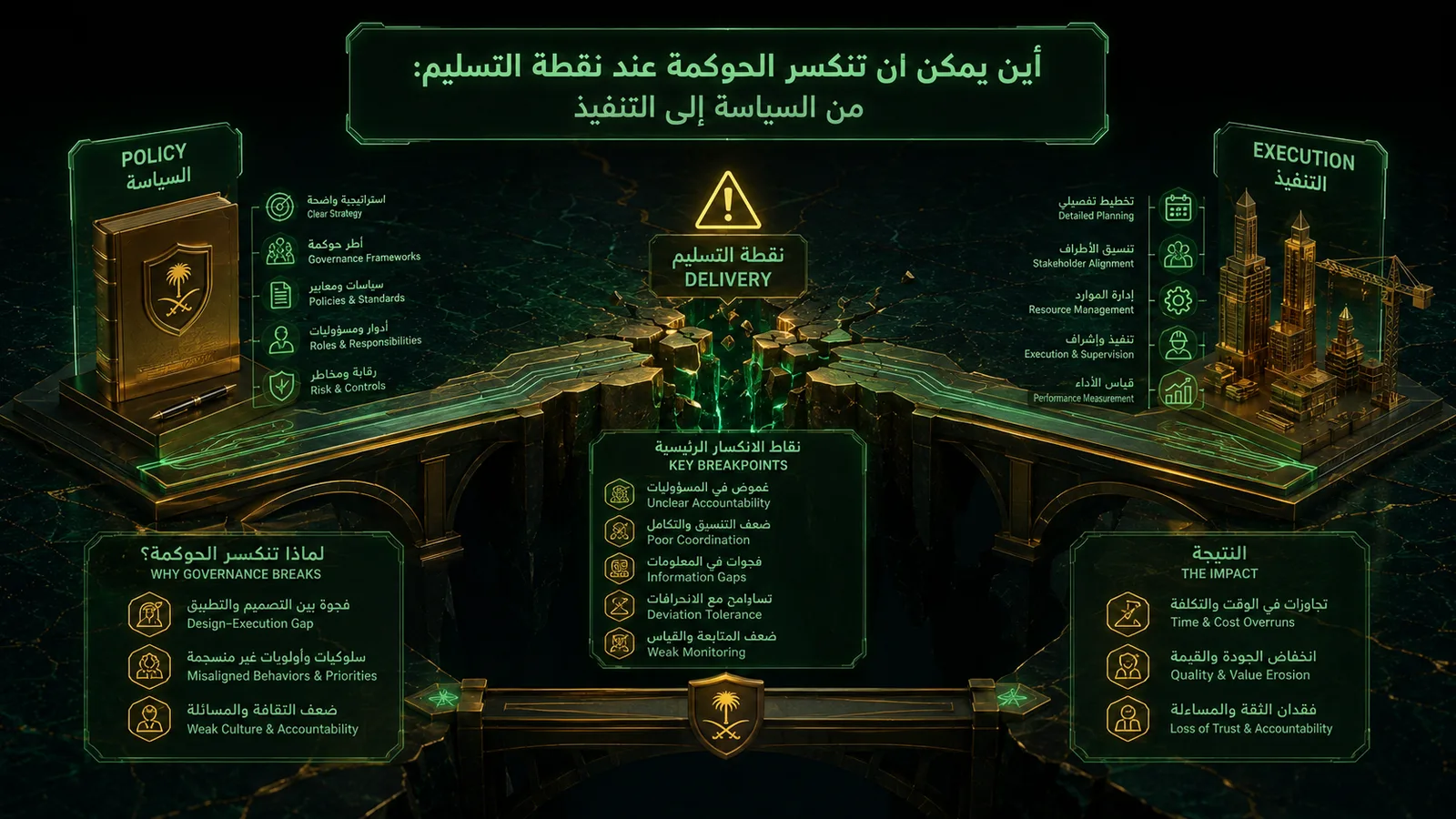

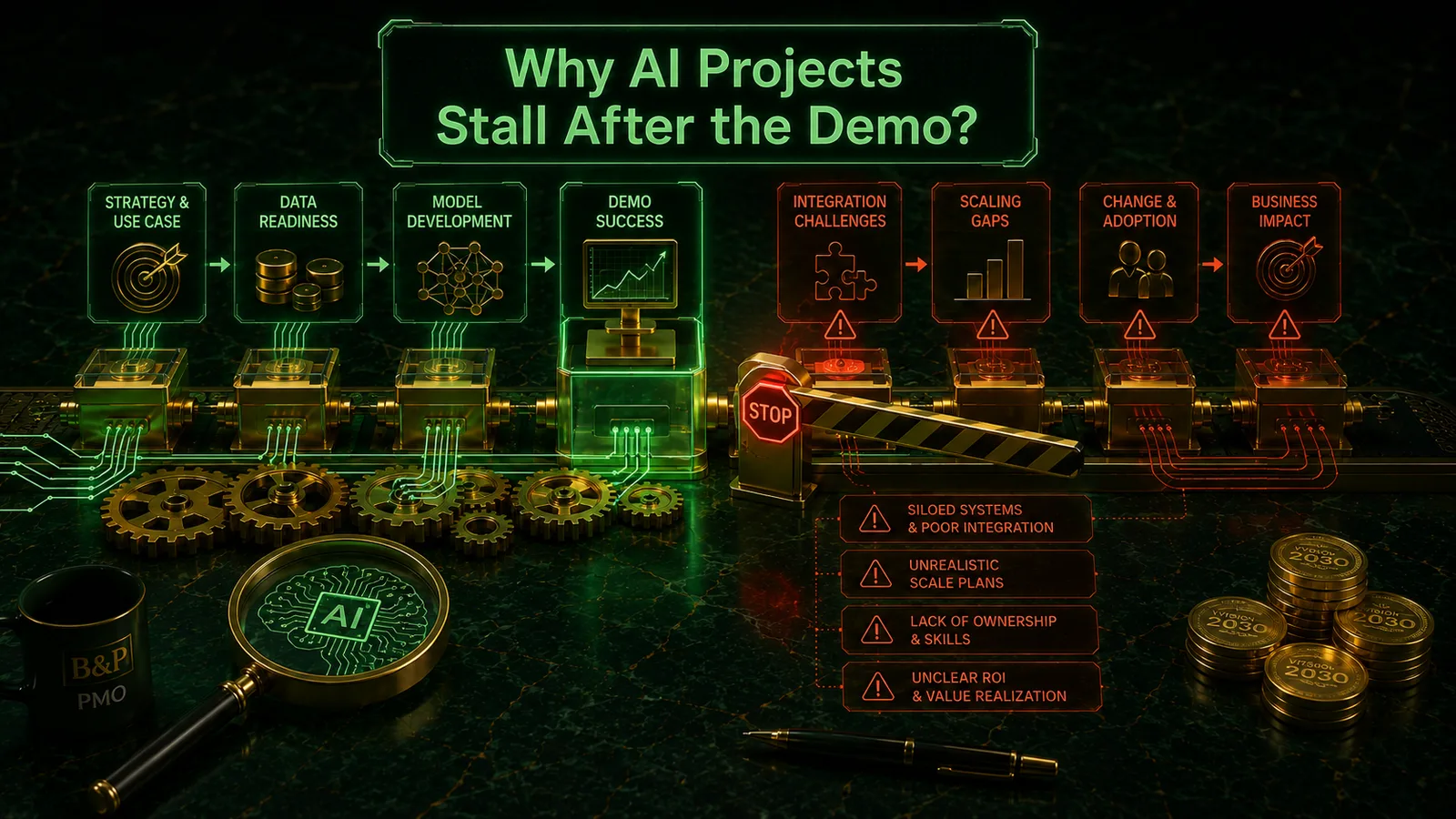
Why AI Projects Stall After the Demo?
From AI Demo to Production: The Operating Model Behind Operational AI
An AI demonstration can be technically convincing. A model may classify documents, generate responses, summarize information, predict an outcome, or automate a repetitive task within a controlled environment.
But the test changes when that capability enters the institution.
Data may be distributed across different systems. Access rights may follow existing permission structures. Workflows may have been designed around human decision-making rather than AI-generated outputs. Ownership of AI outputs may need to be clearly defined. Other systems may require a specific format before they can use the result. Employees may need clear boundaries for when they can rely on the model and when human intervention is required. Security and governance controls may also need to account for how the AI workflow accesses information and takes action.
The question therefore moves beyond whether the AI works in the demonstration.
It becomes whether the capability can operate repeatedly within the institution's existing systems, workflows and control environment.
A Successful Demo Does Not Establish Operational Readiness
A demonstration typically operates within defined and controlled conditions. Inputs are constrained, the use case is narrow, expected outputs are known, and the project team can handle exceptions directly.
Production introduces the capability into a different operating environment.
Institutions work with incomplete records, changing processes, multiple systems, inconsistent data, approval requirements and competing priorities. The AI capability therefore has to function within the environment where the work is actually performed.
This distinguishes between two dimensions of performance: technical performance, which concerns how well the AI performs its intended task, and operational performance, which concerns how that capability functions within the wider workflow.
A model can therefore be technically capable while the surrounding operating environment limits the value delivered by the deployment.
The Operating Model Around the AI
AI discussions often focus on the model: which model to use, how accurate it is, how quickly it responds and what it costs.
These questions matter. They describe the technical capability.
The operating model addresses what surrounds that capability.
It defines where the AI receives its data, which systems it can access, which decisions it can influence, who is accountable for its outputs, what happens when confidence is insufficient, when human approval is required, how actions are recorded, and how the workflow continues after the AI produces its result.
These decisions connect the AI capability to the systems, processes, people, permissions and controls required for repeated use.
The model is one component of the deployment, while the operating model defines the conditions under which that component functions within the institution.
Integration Becomes Part of the AI Project
An institution may already operate enterprise resource planning systems, customer relationship management systems, document repositories, internal databases, communication tools and workflow applications. Integration becomes an operational issue when these systems use different data definitions, ownership boundaries or approval paths.
AI does not eliminate these dependencies.
It has to operate through them.
A model may produce an accurate recommendation while the surrounding workflow lacks a reliable path for delivering that recommendation to the person responsible for acting on it.
The same principle applies to automation.
An AI agent may be capable of completing a task, but its deployment still requires defined boundaries around the actions it can perform, the actions that require approval, the information it can access, and how those actions are monitored.
The AI capability is therefore one component of the wider institutional operating system.
Data Quality Becomes an Operational Issue
AI deployment can make existing weaknesses in the data environment more visible.
Duplicate records, fragmented databases, inconsistent definitions and unclear data ownership can become operationally significant when an AI workflow depends on information from multiple sources.
This does not necessarily mean that AI created these weaknesses. Instead, deployment can expose dependencies that the institution needs to understand before the workflow can operate reliably.
Data ownership, source reliability, update frequency, access rights and relationships between different data sources therefore become part of the operating model.
At scale, unresolved ambiguity in these areas can affect how reliably an AI workflow moves from information to decision and from decision to action.
Governance Needs to Exist Inside the Workflow
Governance becomes operational when its requirements are reflected within the workflow itself rather than remaining confined to policy documents.
The question is how these requirements appear at the point where AI is used.
Depending on the deployment, controls may address sensitive data, model access, human review, audit trails, escalation paths and exception handling.
The control structure also varies according to the type of AI deployment.
A system that generates recommendations may operate within different control boundaries from a workflow that executes transactions or changes records.
The operating boundary is therefore defined not only by policy, but by what the AI is permitted to access, decide and execute within the workflow.
The Human Role Remains Part of the Operating Model
Moving from demonstration to production does not, by itself, determine the appropriate level of human involvement in the process.
The relevant distinction is between decisions that AI supports and decisions for which institutional accountability remains with people.
That distinction affects approval thresholds, escalation rules, accountability and performance monitoring.
A recommendation system may leave the final decision with a human. A transaction-oriented workflow may require approval before execution. A more autonomous workflow may operate within predefined boundaries and escalation conditions.
The operating model therefore connects automation with the points at which human judgment and accountability remain necessary.
Production Requires a Feedback Loop
Production AI needs a mechanism for observing what happens after the system produces an output.
Outputs need to be monitored. Exceptions need to be captured. User feedback needs to reach the operating process. Performance needs to be reviewed against operational outcomes, not model metrics alone.
For production AI workflows, this creates a recurring cycle:
Data → AI decision → Human or automated action → Outcome → Feedback → Governed improvement
The controls and monitoring cadence will vary by deployment and may need to respond when conditions, data or user behavior change. The underlying principle, however, is that operational performance needs to remain observable after the initial implementation.
Measure the Work, Not Only the Model
An AI project should not be evaluated only through model performance in a test environment.
Technical accuracy remains relevant, but it does not by itself describe the effect of the capability on the work around it.
Operational performance provides a way to connect technical capability with institutional value.
That connection can be examined through measures such as workflow completion, cycle time, exception rates, adoption, human intervention and decision quality. The relevant measures will vary according to the role the AI performs.
The objective is therefore not simply to demonstrate that AI can perform a task.
It is to establish whether that capability can function reliably within the work it was designed to support.
From Prototype to Operational Capability
The transition from an AI demonstration to production is therefore not simply a deployment step.
It is a decision about the operating model surrounding the AI capability.
The model itself remains important, but operational viability also depends on connecting it to reliable data, existing systems, defined workflows, clear responsibilities and appropriate controls.
In Saudi operating environments, this operating model can also intersect with national mechanisms relevant to AI and data governance. SDAIA's AI Adoption Framework serves as a guiding reference for AI adoption across sectors, while its Principles and Controls of AI Ethics contribute to the application of ethics throughout the AI-system development lifecycle. The National Data Governance Platform also provides services and tools related to data governance and personal-data protection, including the AI Ethics Assessment tool, which enables entities to conduct a self-assessment of their compliance with AI ethics standards.
These mechanisms do not replace the institution’s operating model. Rather, they form part of the broader governance environment within which an AI deployment may operate.
A demonstration can establish what the AI capability can do.
The operating model determines how that capability functions within the institution's work, controls and accountability structure.