
Where Governance Can Break at the Handover: Policy to Execution
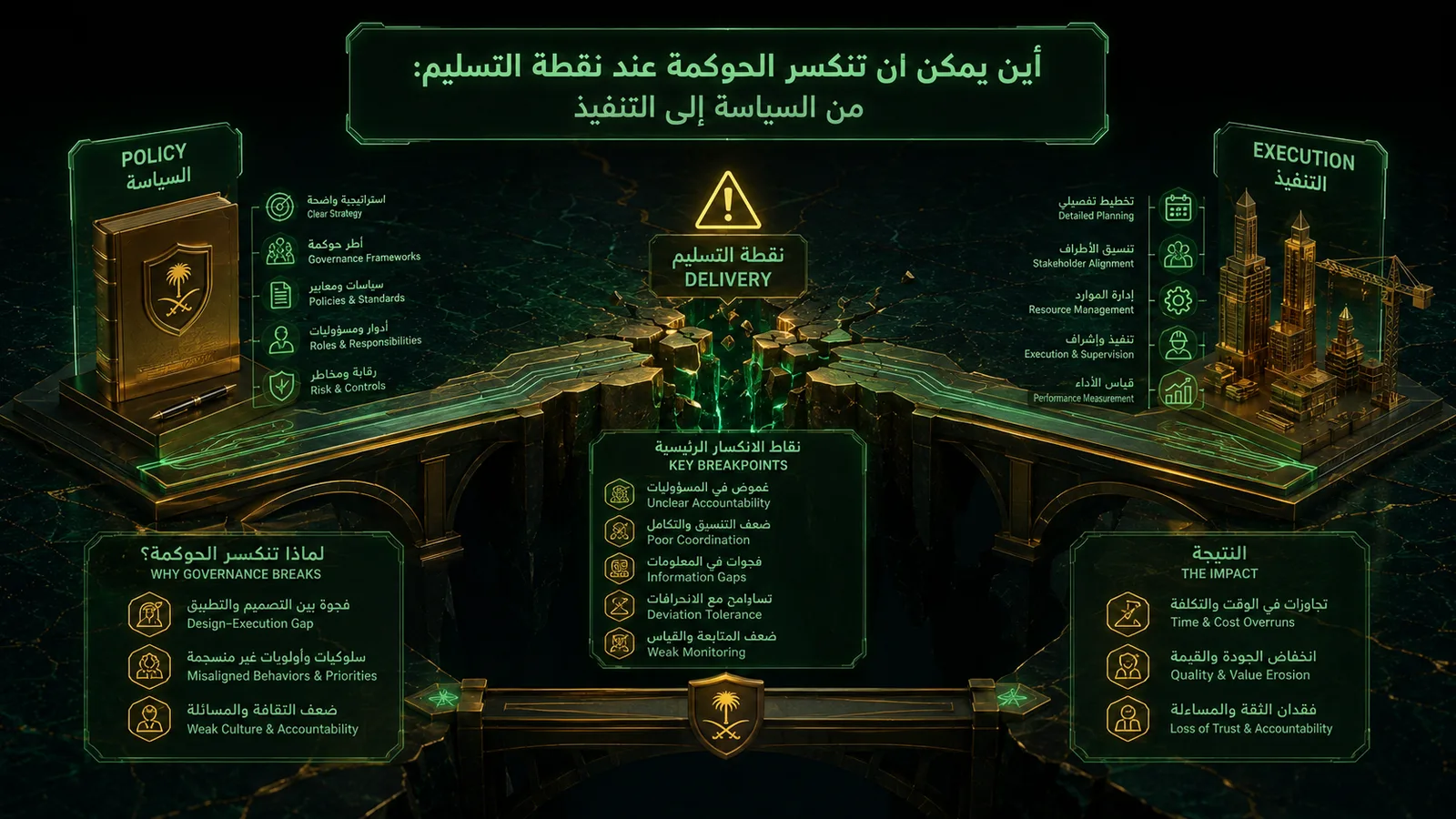
Where Governance Can Break at the Handover: Policy to Execution
A governance framework can look complete.
There is a policy. There are procedures. Responsibilities have been assigned. Controls have been documented. Reporting lines are visible. The board receives periodic updates.
Then the work begins.
A request moves from one team to another. A control depends on an approval that sits with another function. A process is interpreted differently across departments. A system does not enforce an approval that the policy requires. A critical exception reaches an owner who was never clearly defined.
Nothing is necessarily wrong with the policy itself.
The weakness often appears at the handover.
In many organizations, governance can be clearly described at the policy level while becoming less clear as requirements move into processes, systems and decisions.
Policy is not execution
A policy establishes direction.
It defines principles, boundaries, responsibilities and expected behavior. But a policy does not execute itself.
Execution requires translation.
Someone has to turn a policy requirement into a process. That process has to be reflected in systems, approval routes, access rights, documentation and day-to-day decisions.
A translation can create recurring ambiguity, particularly when a requirement passes between teams, systems or decision points without a clear operational owner.
A requirement can be interpreted differently by different teams. A responsibility can be assigned at a high level but not reflected in operational ownership. A control can exist in a document without being embedded in the workflow where the relevant decision actually occurs.
This is why governance should not be assessed only by asking:
"Do we have the right policy?"
The more useful question is:
"Where does this policy become an action?"
The handover is where accountability becomes fragile
Governance often crosses organizational boundaries.
A compliance team may define a requirement. A business function may own the process. Technology may configure the system. A manager may approve an exception. Internal audit may later test whether the control worked.
Each role can be individually clear while the overall chain remains unclear.
The risk appears in the gaps between responsibilities.
Who identifies the issue?
Who makes the decision?
Who records it?
Who approves the exception?
Who verifies that the control operated?
Who owns the outcome?
When these answers are spread across different functions without a clearly designed handover, accountability becomes fragmented.
The organization may have governance everywhere and ownership nowhere.
Process is the translation layer
The process is where governance becomes operational.
A policy may require segregation of duties, for example. But the process must determine which tasks are separated, which approvals are required, when they occur and what happens when the required separation cannot be achieved.
Similarly, a policy may require data protection.
The operational question is not simply whether the requirement exists. It is how access is granted, how decisions are logged, how exceptions are escalated, and how evidence is retained.
Effective governance extends beyond the policy document into the process and control environment. Together, process design and the controls embedded within it carry policy requirements into execution.
Systems can leave governance unenforced
Technology creates another handover point.
A policy can require an approval before a specific action. If the system does not enforce that approval, the organization is relying on memory, training and manual discipline.
That may work under stable conditions, but changes in workload, ownership or exceptions can expose the gap.
Systems should therefore reflect the operating logic of governance wherever practical.
This does not mean every policy requirement must become an automated control.
It means the organization should know which controls are:
- policy-based;
- process-based;
- system-enforced;
- human-reviewed;
- or detective rather than preventive.
That distinction makes the control environment easier to operate and easier to test.
Documentation is evidence, not governance itself
Organizations can accumulate policies, procedures, templates, approval forms and registers while still having weak operational control.
The presence of documentation shows that something has been defined.
It does not automatically prove that it happened.
A stronger governance model connects requirements to evidence.
If a control requires approval, the organization should know where that approval is recorded. If an exception requires escalation, there should be a defined record of the decision. If a responsibility is assigned, the operating process should make that responsibility visible.
Workflow-generated evidence can reduce the need to reconstruct control evidence later and can strengthen governance resilience.
Exceptions test the governance model
A process can look well controlled when everything goes according to plan.
The real test often comes when something does not.
A transaction requires urgent handling. A system is unavailable. A responsible person is absent. A business unit needs to deviate from the standard process. New regulations or internal requirements introduce an unfamiliar scenario.
These moments expose whether governance is designed for reality or only for the normal path.
A mature framework defines the standard route and the handling of situations where that route cannot be followed.
That includes escalation, temporary authority, exception approval, documentation and post-event review.
Adapting governance requires operational ownership
As organizations operate across different markets, regulatory environments, business models and operating contexts, governance requirements may need to be adapted to the relevant local context. That adaptation introduces another handover: a common governance requirement must move from the central framework into local processes, systems and decisions.
But local adaptation should not mean creating disconnected interpretations of the same governance framework.
In practice, the underlying control objective can be preserved while the operational implementation is adapted to the relevant context. Here, the control objective is the outcome the control is intended to protect.
That requires clear ownership.
Someone must own how a requirement is translated locally, how changes are communicated, and how the implementation remains aligned with the organization's wider governance structure.
The board sees the outcome, not the handover
At board level, governance is often represented through dashboards, risk indicators, incidents, audit findings and management reporting.
These are important.
But many governance weaknesses form much earlier, inside operational handovers that are invisible at board level until they produce a failure, delay or exception.
This is why board oversight benefits from understanding not only what controls exist, but also where accountability moves between functions.
For the board, the handover is where distributed accountability and control gaps may become visible in operational reporting and exceptions.
From governance documents to operating controls
The objective is not to create more governance for its own sake.
It is to keep governance connected as requirements move from policy to process, from process to system, and from system to daily execution.
A practical governance framework can be tested through four connected questions:
What must happen? Who owns it? How is it executed? What evidence proves it happened?
Together, these questions test whether governance requirements remain connected to the processes, controls, systems and accountability structures through which organizations actually operate.
At B&P GRC, the focus is on building that connectedness between governance requirements and the processes, controls, systems and accountability structures through which organizations actually operate.
The policy sets the direction.
The process translates it.
The system enforces it where the control has been designed for system enforcement.
The handover is a key point at which governance can remain effective or weaken in execution.