
Prototype vs. MVP vs. No-Code: Which Do You Need?
If you are a founder, product lead, or innovation director in Saudi Arabia trying to figure out how to take a digital product idea from concept to reality, you have almost certainly run into three terms used interchangeably: Prototype, MVP, and No-Code. In the high-stakes world of technology, they are often treated as synonyms. They are not. Choosing the wrong one at the wrong stage is one of the most common and most expensive mistakes early-stage teams make.
The Saudi Context: Why This Decision Matters More Than Ever
Riyadh jumped 60 places in the 2025 Global Startup Ecosystem Report to rank 23rd globally, a direct reflection of the rapid maturation of the Kingdom's startup infrastructure. Early-stage investments made up 89% of Saudi VC transactions in H1 2025, the highest proportion among MENA's top markets. Saudi Arabia now boasts over 1,597 active startups, with a recorded growth rate of 236.8%.
What a Prototype Is: The Evidence Engine
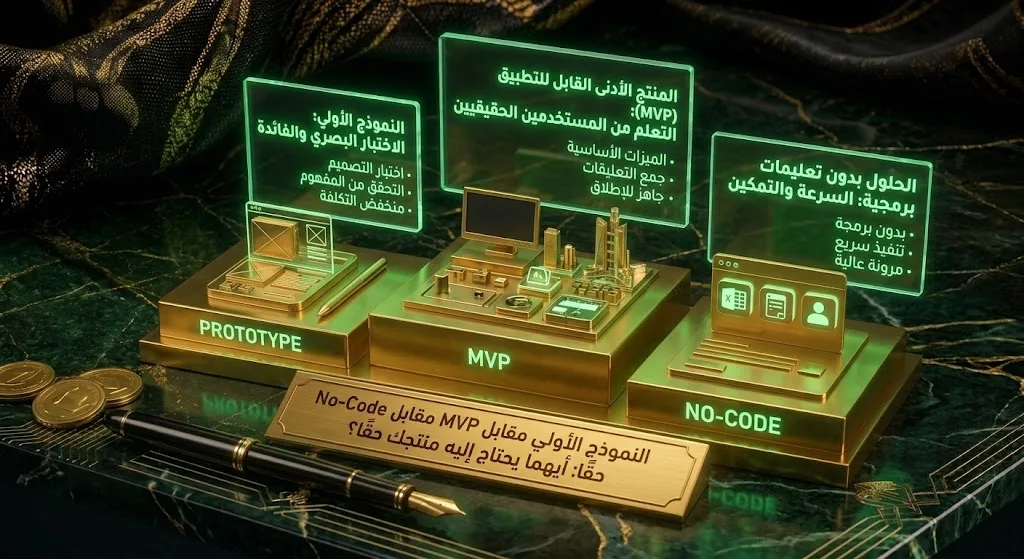
A Prototype is a functional, code-based representation of one or more core user workflows. It is not a finished product. It is not designed to be scalable, secure at production standards, or feature-complete. Its entire purpose is to demonstrate how a product actually behaves and answer two questions: Can this be built? And does it behave the way we assumed it would when a real user touches it?
- When it's right: When you need to test a specific product assumption, demonstrate a working concept to investors, or make a credible case for a larger development investment without committing the full budget upfront.
- When it's wrong: When you need a scalable application with enterprise security and complex third-party integrations.
What an MVP Is: The Market Entry Tool
An MVP (Minimum Viable Product) is a fully functional first version of a product with enough features to attract and retain real users while generating market feedback. An MVP is production-grade by definition. It is built to be used, not just demonstrated. The prototype informs what to build, the MVP tests whether the market will adopt what you built.
- When it's right: When the core product assumptions have already been validated, the target user is clearly defined, and the team is ready to acquire real users.
- When it's wrong: When you are still at the assumption-testing stage. Building an MVP prematurely creates massive technical debt and costs significantly more in both time and capital.
What No-Code Is: The Quick Hypothesis Tester
No-code tools (like Bubble, Webflow, and Xano) allow founders to build functional web applications without writing traditional code. They are fast to set up and accessible to non-technical founders. However, no-code applications are built on proprietary platforms. When a product outgrows those constraints, which happens quickly in the high-growth Saudi market, migrating to a production codebase often means rebuilding from scratch.
- When it's right: When speed of hypothesis testing is the only priority and the use case is simple.
- When it's wrong: When the core feature is technically complex, when code ownership matters, or when you need to integrate with complex regional systems like SAMA or CMA sandboxes.
The No-Code Trap and Its Impact on Valuation
Many entrepreneurs fall into the trap of using No-Code for technically complex platforms. When it comes time for Technical Due Diligence by a VC firm, owning a fully organized, proprietary source code significantly inflates your company's valuation. Investors aren't just buying a UI. They are acquiring a Technical Asset.
Custom-coded prototypes provide the ownership and scalability VCs look for. No-code tools create a technical ceiling that can stifle growth.
/ B&P
The Validation Layer: The Step Most Founders Skip
The gap between a no-code experiment and a production MVP is the Validation Layer, the structured process of defining which assumption needs to be tested, building the minimum functional version to test it, and documenting what the evidence says. Skipping validation is not a time saver, it is the single biggest risk amplifier in the entire startup journey.
How Bisher & Partners Can Help
LaunchPad Sprint from Bisher & Partners sits exactly at the Validation Layer. We deliver functional, code-based web prototypes in 14 to 30 days, built around the core user workflows that matter most for testing your business model. Unlike no-code tools, we provide full code ownership via GitHub. For founders who validate and are ready to move to production, the full LaunchPad Sprint fee is credited toward B&P's GSED service.