
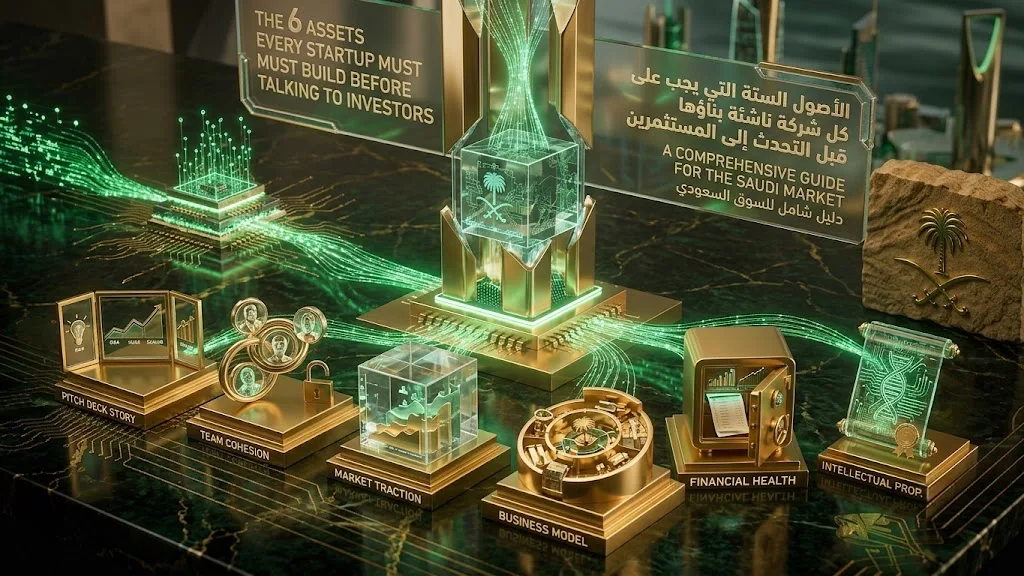
The 6 Essential Startup Assets for Saudi Founders
Many founders believe that fundraising starts with a pitch deck. They spend weeks perfecting slides and practicing their "hook." In reality, successful fundraising starts much earlier in the quiet months of internal structuring. Long before you speak to your first VC, your startup is already being evaluated based on something far deeper than a presentation: Your Readiness.
In today’s competitive environment, especially in fast-growing ecosystems like Saudi Arabia, investors are no longer funding "ideas" on napkins. With the maturity of the KSA market under Vision 2030, investors are looking for structure, clarity, and evidence of execution. This is where startup investment assets become critical. Without the right foundation, even the most promising startups in Saudi Arabia struggle to move forward.
Without venture capital preparation, conversations stall. Without structure, trust breaks. Without clarity, deals disappear during the final stages of due diligence. This guide breaks down the six essential startup fundraising assets every founder must build before approaching investors and how these assets shape your ability to secure the capital you need to scale.
Why Startup Readiness Matters Before Fundraising
Fundraising is not a singular moment; it is a rigorous process of elimination. The startups that succeed are the ones that treat startup funding preparation as a core business function. When you enter a room with a Saudi venture capital firm or a sophisticated angel group, they are evaluating you across multiple dimensions, often using an implicit startup readiness checklist.
They want to see:
- A company that is legally and operationally structured.
- A financial business model that makes mathematical sense.
- A team that possesses a "command of the numbers."
- A vision that is backed by tangible investor documents that startup teams can produce instantly.
This is the true meaning of investment readiness for startups. It is not about presenting a good game; it is about being a high-quality, institutional-grade company. In the 2026 market, "potential" is a commodity, but "readiness" is a rare and valuable asset.
Asset 1: A Structured Legal Foundation
The first thing investors look for, often before they even deep-dive into your product, is the clarity of your ownership and legal setup. In Saudi Arabia, with the New Companies Law, the bar for startup legal structure has never been higher.
What investors expect before funding a startup regarding its legal health:
- Clear Shareholder Agreements (SHA): No "handshake" deals. Everything regarding vesting, drag-along, and tag-along rights must be documented.
- Defined Equity Distribution: A clean Cap Table that doesn't have "dead equity" or unallocated pools.
- Intellectual Property (IP) Ownership: Clear proof that the IP belongs to the company, not the founders personally.
- Compliance: Proper registration with MISA (if applicable) and the Ministry of Commerce.
Why it matters: Because investors are not just investing in your idea; they are buying a piece of your company. If the company’s legal "house" is built on sand, the deal stops immediately to avoid future litigation or ownership disputes.
Asset 2: A Real Financial Model
A strong startup financial model is one of the most important investor documents startup teams must prepare. This is where your business becomes "logic" instead of "poetry."
Your financial modeling for startups should clearly show:
- Revenue Streams: How exactly does a Saudi Riyal enter the bank?
- Cost Drivers: What are the variable and fixed costs linked to growth?
- Scalability: How does the business look when you have 10,000 customers vs. 100?
- Startup Revenue Projections: Based on "Bottom-Up" logic (real conversion rates and sales capacity) rather than "Top-Down" guesses.
- Burn Rate & Runway: A clear understanding of how long the investment will last and exactly what milestones it will fund.
Why it matters: Numbers are how investors validate your story. If your slides say you are a "global leader" but your startup unit economics show you lose money on every transaction, you lose all credibility.
Asset 3: A Complete Investor Data Room
One of the most overlooked startup fundraising assets is the investor data room. In the Saudi market, where the speed of the ecosystem is accelerating, being slow to provide documents is a deal-killer.
How to prepare your startup for investors with a professional data room: A well-prepared data room is your "Single Source of Truth." It should be organized, secure, and contain:
- Financials: Historical, tax filings, and the forward-looking model.
- Legal: Articles of Association, SHAs, and IP assignments.
- Operational: Key contracts with suppliers or big Saudi corporate clients.
- HR: Employment contracts and the ESOP plan.
Why it matters: Speed and organization build trust. A messy or incomplete data room signals a "Chaotic Startup." A structured one signals an "Institutional Asset" that is ready for big checks.
Asset 4: A Clear Investment Narrative
Data alone doesn't close deals; stories do. However, this story must be an "Investment Narrative," which is different from a "Customer Narrative." While customers care about features, investors care about returns, moats, and exits.
A strong narrative explains:
- Timing: Why is now the perfect time (e.g., changes in Saudi regulations, consumer behavior shift)?
- Defensibility: Why won't a giant competitor crush you in six months?
- The "Why You": Why is this specific team the only one that can win this market?
Why it matters: Confusion kills deals. If an investor can’t explain your business to their investment committee in two minutes, they won't invest. Consistency across all startup investment assets is key.
Asset 5: Defined Unit Economics
Many founders focus on growth at all costs. In the 2026 investment climate, Saudi VCs focus on sustainability. This is where startup unit economics become essential. You need to prove that your "Unit" (one customer, one delivery, one subscription) is profitable.
What investors expect before funding a startup:
- CAC (Customer Acquisition Cost): What is the real cost of a lead in the Saudi market?
- LTV (Lifetime Value): How much margin do you make over the customer's life?
- Payback Period: How many months until you break even on that customer?
Why it matters: This is the "Engine" of your business. If the engine is broken, adding more fuel (investment) won't make the car go faster; it will just make the engine explode sooner.
Asset 6: A Practical Startup Readiness Checklist
The final asset is not a document; it is a system. A structured startup readiness checklist ensures that nothing is overlooked. This is your "Pre-Flight" check before you take off into the fundraising market.
Your startup investment checklist before fundraising should include:
- Internal Audit: Are all founder roles and salaries documented?
- Tech Due Diligence: Is your code documented and secure?
- Market Validation: Do you have "Social Proof" or LOIs from Saudi partners?
- Communication Plan: Do you have a timeline for following up with VCs?
Why it matters: Readiness is not accidental; it is built intentionally. This checklist is what keeps the momentum of a deal alive when things get intense.
The Saudi Investor Mindset: Understanding Local Nuances
To truly master startup fundraising preparation, you must understand the specific mindset of investors in the Kingdom. Saudi investors ranging from tier-1 VCs to sophisticated Family Offices operate with a unique blend of global standards and local cultural values.
- Relationships and Trust (Majlis Logic): While the investor documents that startup teams provide are critical, the relationship is the catalyst. Saudi investors value long-term commitment. They want to see that you aren't just looking for a "quick exit," but are committed to building a pillar of the Saudi economy.
- Alignment with Vision 2030: This is not just a buzzword. Investors look for how your startup contributes to the Kingdom’s digital transformation, job creation, or specific sector growth (FinTech, Logistics, Tourism).
- The "Execution over Idea" Filter: In KSA, the ability to navigate local regulations and build the right partnerships is more valuable than a "unique" idea. Your startup readiness checklist should demonstrate your ability to execute locally.
- Reputation Risk: Saudi investors are highly protective of their reputation. This is why startup due diligence preparation is so intense here. They need to ensure that your company’s legal and ethical foundation is beyond reproach.
Understanding these nuances ensures that your how to prepare your startup for investors strategy is not just generic, but "Saudi-Ready."
What Happens When These Assets Are Missing?
When startups approach investors without these startup fundraising assets, the outcome is almost always "The Ghosting Effect."
- Conversations stall: Investors ask for a document, and the founder takes two weeks to find it.
- Trust evaporates: Inconsistencies between the pitch deck and the financial model raise red flags.
- Due diligence reveals gaps: Hidden legal debts or messy equity splits come to light.
- Deals fall apart: Often at the very last minute, leaving the startup with zero runway.
The issue in these cases is rarely the idea but the lack of startup due diligence preparation.
How to Build These Assets the Right Way
Building startup investment assets requires a fundamental shift in mindset. You must move from "Building a Product" to "Building a Company."
The Startup Fundraising Preparation Guide:
- Think like an investor: Look at your company through the lens of risk and return.
- Audit your legal debt: Fix your shareholder agreements now, not when the term sheet arrives.
- Build your model from the bottom up: Use real data from the Saudi market.
- Organize your Data Room early: Treat it as a "live" folder of your business health.
Startups that follow this path move faster, negotiate from a position of power, and close deals at higher valuations.
The Competitive Advantage of Being Prepared
In the 2026 Saudi market, capital is abundant, but it is "Smart Capital." It flows to the most prepared. Investment readiness for startups provides a massive competitive advantage:
- Faster fundraising cycles: You close in weeks, not months.
- Stronger investor confidence: VCs feel they are partnering with a professional.
- Better valuation positioning: When you have all your assets ready, you aren't "desperate"; you are "selective."
- More control: You set the pace of the negotiation.
Conclusion
Fundraising is not about "convincing" investors; it is about removing their doubts. And doubts only disappear when your startup is backed by real, tangible startup investment assets.
The six assets outlined in this guide, Legal, Financial, Data Room, Narrative, Unit Economics, and Readiness Checklistare not optional extras. They are the foundation of any serious venture capital preparation. In the thriving Saudi ecosystem, the startups that succeed are not just the ones with the most innovation; they are the ones with the most readiness.
If you are planning to raise capital, start building your foundation today. Don't wait for the meeting to start preparing.
- Review your current assets.
- Identify what is missing (Legal? Financial?).
- Strengthen your structure with professional help.
- Prepare before the first email is sent.
[Start your Investability Diagnostic at bishernp.com]
Because in the world of startups, investors do not fund potential alone; they fund preparation.
FAQs
Q1: What documents do investors need from startups?
At a minimum, they need a Pitch Deck, a 3-Statement Startup Financial Model, a Cap Table, and a fully organized Investor Data Room containing legal and operational contracts.
Q2: How to build startup investment assets efficiently?
Start early. Use a startup readiness checklist to audit your company every quarter. Focus on fixing "Legal Debt" and cleaning up your unit economics before you start active pitching.
Q3: What do investors expect before funding a startup in Saudi Arabia?
They expect high KSA regulatory compliance, alignment with Vision 2030 sectors, and a team that understands the local market dynamics and unit economics.