
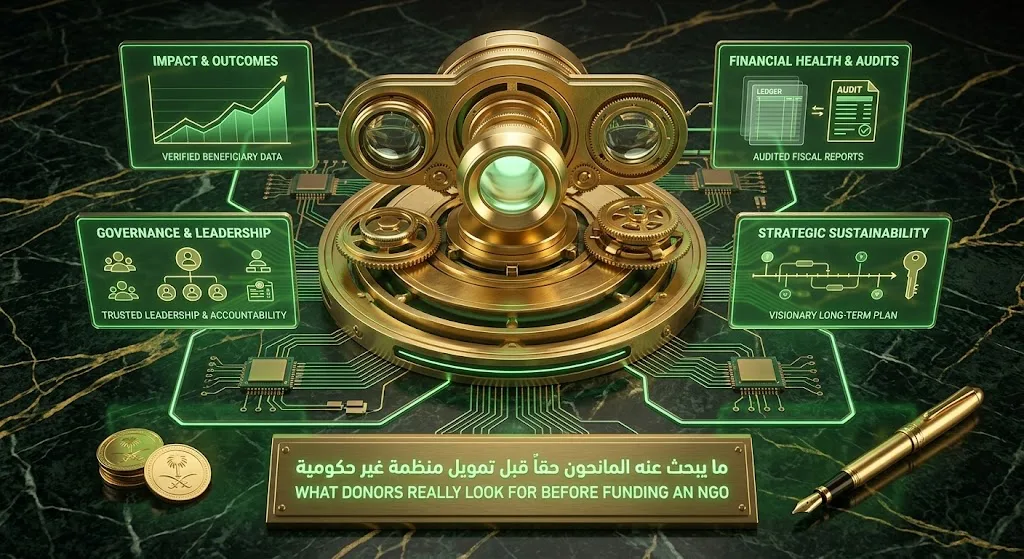
What Donors Really Look for Before funding an NGO
In the vibrant ecosystem of Saudi Arabia’s social sector, a silent revolution is taking place. We have moved past the era of traditional giving into an era of social investment. For many nonprofit leaders, there is a recurring moment of frustration: you have a project that can change thousands of lives, a passionate team, and a clear need, yet the Acceptance Letter from a major donor never arrives.
The reality is that modern donors in the Kingdom, from the Ministry of Human Resources and Social Development (MHRSD) to the largest family offices and corporate CSR departments, have developed a sophisticated Internal Filter. They are no longer captivated solely by the nobility of your mission. Instead, they are looking for the architectural strength of your organization. They are searching for a partner that is built to last, not just a project that is built to spend.
The Shift Toward Institutional Due Diligence
In the current Saudi market, donor requirements have shifted from "What are you doing?" to "How are you built?" This is the core of NGO funding criteria today. Donors are performing what is known as Institutional Due Diligence. They want to see that your NGO functions with the precision of a private corporation while maintaining the heart of a social mission.
This shift is driven by the professionalization of the Third Sector under Vision 2030. Donors now view themselves as Impact Investors. As an investor, their primary concern is the mitigation of risk. They want to ensure that their capital, whether it is 100,000 or 10 million Riyals, is placed in a Safe Vessel. This vessel is your nonprofit organizational structure.
Financial Transparency: The Language of Trust
If you want to understand the heart of a donor’s decision, you must look at your balance sheet through their eyes. Financial transparency NGO standards are the primary language of trust in the nonprofit world. In the Saudi context, transparency is no longer about just showing where the money went; it is about proving the integrity of the process that moved the money.
Donors look for Audit-Readiness. They want to see that your organization follows IFRS standards and has clear internal controls that prevent any shadow of mismanagement. When an NGO presents a transparent financial history, it signals to the donor that the organization is Investable. Without this transparency, even the most innovative project will be flagged as high-risk, leading to an immediate rejection.
Governance as a Competitive Advantage
Many NGOs view governance as a regulatory burden, but the most successful organizations in the Kingdom treat governance development as a competitive advantage. When a donor looks at your organization, they are looking at your Board of Directors and your executive policies.
They are looking for Institutional Maturity. This means a board that provides actual strategic oversight and an executive team that operates within clear delegated authorities. Nonprofit credibility is inextricably linked to governance. A donor feels secure when they know that the organization is governed by systems and policies rather than the whims of a single charismatic leader. In a professionalized market, System-Led organizations always win over Leader-Led organizations.
The Digital Trust Certificate: Technology as a Donor Requirement
In the modern Saudi landscape, donors equate manual processes with high risk. One of the new and critical donor requirements is the presence of a "Digital Infrastructure." When an organization manages its projects via paper or fragmented spreadsheets, it signals a lack of control. Donors are now prioritizing NGOs that utilize integrated ERP systems and digital project management tools. They want to see that your data is secure, your reporting is automated, and your operations are "Tech-Enabled." For a donor, a digital NGO is a transparent NGO, as it allows for real-time tracking of funds and outcomes, significantly boosting your nonprofit's credibility.
The Social ROI (Return on Investment) Factor
A new and critical element in what donors look for in NGOs is the ability to measure and communicate Social ROI. In the past, reporting that you distributed 1,000 blankets was enough. Today, donors want to know the long-term impact of those blankets on the health and stability of the recipients.
Donors are looking for Data-Driven Impact. They prioritize NGOs that have established Key Performance Indicators (KPIs) and utilize digital tools to track social change. If your organization can prove that every Riyal invested generates a specific, measurable social return, you move to the top of the donor’s list. This level of analytical sophistication is a hallmark of nonprofit operational efficiency and is a major determinant in large-scale funding rounds.
Strategic Alignment: Speaking the Language of Vision 2030
Donors in Saudi Arabia are no longer looking for "isolated" good deeds. They are looking for NGOs that act as "Strategic Partners" in the national transformation. To win major funding, your organization must demonstrate how its goals align directly with specific Vision 2030 programs, such as the Quality-of-Life Program or the Human Capability Development Program. This is a key part of NGO funding criteria that many miss. When you can show that your project is a brick in the wall of the Kingdom's national strategy, the donor stops seeing you as a "charity" and starts seeing you as a "National Asset."
Regulatory Alignment with the NCNP
In Saudi Arabia, the National Center for Non-Profit Sector (NCNP) has set high bars for compliance. One of the hidden donor requirements is ensuring that the NGO is in perfect standing with national regulators. Donors often perform a Compliance Check before even reading the project proposal.
They look for your Compliance Score and your adherence to the latest circulars and regulations. An NGO that is proactive in its compliance is seen as a Stable Partner. On the other hand, any history of regulatory friction is a massive red flag. Institutional excellence means being a model citizen in the eyes of the Saudi government, which in turn builds an unshakable foundation of nonprofit credibility.
Risk Mitigation: The "Safety First" Donor Mindset
Donors are fundamentally "Risk-Averse." Before they think about the "Upside" of your impact, they think about the "Downside" of a potential scandal or failure. They look for your "Risk Management Framework." Do you have a plan for financial fluctuations? Do you have an internal audit committee? Do you have a "Whistleblower Policy"? Organizations that can present a formal risk mitigation plan provide a "Psychological Safety Net" for the donor. In the competitive world of NGO funding criteria, the organization that proves it can handle a crisis is the one that receives the most significant investments.
The Risk of "Charismatic Failure"
Donors are increasingly wary of Charismatic Failure. This happens when a brilliant leader starts an NGO, but because there is no nonprofit organizational structure, the organization collapses or stagnates when that leader departs.
Donors are looking for Succession Readiness. They want to see a middle-management layer that is empowered and systems that are documented. They fund organizations that have Institutional Memory. By proving that your NGO is a Machine for Impact that can function independently of its founders, you provide the ultimate assurance to a long-term donor.
Capacity Building: Investing in the People Behind the Mission
A secret that tops donors know is that "Systems don't run organizations; people do." Therefore, they look for evidence of continuous "Capacity Building." Donors are impressed by NGOs that invest in training their staff, developing their leadership, and fostering a culture of professional excellence. If your NGO improvement plan includes a budget for staff development, it tells the donor that you are building a "High-Performance Team." They are much more likely to fund an organization that prioritizes the professional growth of its human capital, as this is the ultimate guarantee of long-term project success.
Operational Clarity: The Bridge to Multi-Year Funding
The holy grail for any NGO is multi-year, sustainable funding. However, you cannot secure a three-year commitment with a one-year structure. Donors look for Operational Clarity. This involves having clear Standard Operating Procedures (SOPs) and a scalable model.
When a donor sees that your operations are Clockwork, they are more likely to commit to long-term partnerships. They see that you have the nonprofit scalability required to handle larger budgets over longer periods. This clarity turns a Grantor-Grantee relationship into a Strategic Alliance.
Conclusion: From Grant Seeker to Social Partner
The journey to securing major funding in Saudi Arabia is a journey of institutional transformation. Understanding what donors look for in NGOs requires a shift in perspective: stop looking at what the donor can give you, and start looking at what you can offer the donor in terms of reliability, transparency, and impact.
Financial transparency, institutional credibility, and governance are not just checkboxes. They are the pillars of a professional institution that is ready to lead. In the era of Vision 2030, the organizations that will thrive are those that build a World-Class Engine before they ask for World-Class Fuel.
Is Your NGO Ready for the Next Level of Funding?
Donors are searching for organizations that are Funding Ready. Are you one of them? If your organization struggles to provide the level of transparency or governance that modern donors demand, it is time to re-engineer your foundation.
The NGO Qualification Program (NGOQ) by B&P is the definitive solution to bridge your institutional gaps. We help you move from a hopeful mission to an investable institution by mastering:
- High-Grade Financial Transparency NGO Systems.
- Strategic Governance Frameworks that Mitigate Risk.
- Measurable Social ROI Models for Vision 2030.
Your Path to Institutional Excellence Starts Here:
- Book a Free Diagnostic Session: Uncover your Readiness Gaps before the donor does.
- Request a Funding Readiness Audit: See how your organization scores against global and local standards.
- Start Your Transformation Journey: Build the institution that donors are looking for.
[Contact B&P Today – Engineering the Future of Impact. Building Institutions that Last.]
• Website: www.bishernp.com
• Email: contact@bishernp.com
FAQs
Q1: What is the single most important factor a donor looks for in a Saudi NGO today?
While the social mission is important, the "Single Filter" for modern donors is Institutional Reliability. Donors in the KSA market, especially under the oversight of the NCNP, are looking for organizations where the risk of failure is minimal. This reliability is proven through financial transparency, NGO systems, robust governance, and a track record of regulatory compliance.
Q2: How can an NGO prove its "Credibility" if it is relatively new or small?
Nonprofit credibility is not solely based on the number of years in operation; it is based on the quality of your systems. A small NGO with a "Ready-to-Pitch Dossier" containing audited financials, clear SOPs, and a professional governance charter will often win more trust than a large, disorganized organization that relies on old, informal methods.
Q3: Why do donors emphasize "Financial Transparency" more than the project's impact?
Transparency is the prerequisite for impact. If a donor cannot trust your financial transparency NGO standards, they cannot trust that their funds will actually reach the beneficiaries. In the eyes of a professional donor, a lack of transparent reporting is a "Red Flag" that signals potential mismanagement, regardless of how great the project idea is.
Q4: What are the specific "Donor Requirements" regarding Vision 2030?
Donors are looking for "Strategic Alignment." They want to see that your NGO is not working in isolation but is contributing to specific national goals, such as increasing the volunteer base or enhancing the quality of life. Demonstrating that your organization speaks the "Language of the Vision" is a key part of modern NGO funding criteria.
Q5: How does the NGO Qualification Program (NGOQ) help us meet these criteria?
Our program acts as a "Bridge to Readiness." We don't just give you advice; we re-engineer your internal engine. We help you build the financial transparency systems, the risk management frameworks, and the operational clarity that donors explicitly look for. By the end of the program, you possess a "Dossier" that proves your institutional excellence to any local or international donor.
Q6: Can a weak organizational structure lead to a donor withdrawing existing funding?
Yes. Modern grant agreements in Saudi Arabia often include "Institutional Compliance" clauses. If an NGO fails to maintain governance standards or provides vague financial reports, donors may exercise their right to pause or withdraw funding to protect their own reputation and ensure accountability.
Q7: Is "Digital Transformation" really a requirement for funding?
In the current Saudi landscape, yes. Donors equate "Manual Systems" with "Human Error" and "Opacity." Having a digital infrastructure for your finances and projects is now a core part of what donors look for in NGOs, as it provides the real-time data and transparency they need to feel secure in their investment.
Q8: How do we start building the credibility donors want?
The first step is an "Institutional Health Check." You need to identify your "Readiness Gaps," the areas where you fail to meet donor requirements. Our NGO Qualification Program starts with this exact diagnostic to provide you with a clear roadmap from being a "mission-led" initiative to a "donor-ready" institution.